
Indian mobile and Web consumers speak in 30 languages and around 1,600 dialects.

Overseas funds have been spooked by several policy measures taken by the government in the past few years

The e-invoicing system will be rolled out in a phased manner from January 1 on a voluntary and trial basis, beginning with firms with a turnover of Rs 500 crore, while businesses with a turnover of Rs 100 crore or more will be required to do it from February 1.

As Covid-19 cases surge in India, companies have realised it's a tightrope walk between maintaining production and ensuring employee safety.

The new definition under the Code of Wages, 2019, includes three components: basic pay, dearness allowance and retention payment.

Parliament has cleared the Mines and Minerals (Development and Regulation) Amendment Bill, 2023, recently. The objective of the Act is to invite investments from the private sector, including foreign companies, for mining minerals such as lithium and other critical minerals. Other than lithium, some of these minerals were classified as atomic minerals, including beryl and beryllium, niobium, titanium, tantalum and zirconium.

Additional solicitor-general says extra-neutral alcohol liable to new tax

The issues around trade gaps, especially around steel and aluminium tariffs imposed by the US, will be addressed separately.

Under the new system, Infosys will handle end-to-end solution - from e-filing to return assessment to refund processing. The new portal is also expected to process the refunds within one day of filing of tax returns, in huge relief for taxpayers.

The government has notified mandatory requirement of e-invoicing for B2B transactions for businesses with a turnover over Rs 100 crore with effect from January 1, 2021. Under Goods and Services Tax (GST) law, e-invoicing for business-to-business (B2B) transactions is mandatory for companies with turnover of over Rs 500 crore from October 1. In a notification, the Central Board of Indirect Taxes and Customs (CBIC) said e-invoicing will be extended to businesses with a turnover over Rs 100 crore from January 1.

More people working in India's technology industry have lost their jobs in the first six months of 2023 than in the corresponding period in 2022.
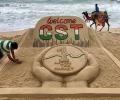
GST collections in February grew 18 per cent to over Rs 1.33 lakh crore in February even as the Omicron wave dented the month-on-month collection momentum. This is for the fifth time in the current fiscal that the Goods and Services Tax (GST) collection has crossed Rs 1.30 lakh crore mark. Also, this is the first time, cess collection has crossed the Rs 10,000 crore mark, signifying recovery in certain key sectors, especially automobile sales, the finance ministry said on Tuesday.

Despite a steady collection rate, the government faces a steep Budget target of Rs 6.1 trillion for CGST for 2019-20.

The government has notified a host of procedural changes in the GST rules, including levy of interest for wrongful utilisation of ITC and turnover threshold for filing annual returns for the 2021-22 fiscal. The changes were vetted by the Goods and Services Tax (GST) Council at its meeting last week. With the amendments notified by the Central Board of Indirect Taxes and Customs (CBIC), businesses have also been allowed to make tax payments on the GSTN portal by using IMPS and UPI payment modes.

India's exports may have touched an all-time high of $422 billion in 2021-22 but recession in key western markets and geo-political crisis due to the Russia-Ukraine war are expected to impact the growth of the country's outbound shipments in 2023. All the global trade promoting factors like political stability, movement of goods, adequate availability of containers and shipping lines, demand, stable currency and smooth banking systems are in disarray. Adding to the woes, COVID cases have again started rising in countries like China, Japan, South Korea and the US.

To improve compliance, govt may introduce lottery reward for filing GST. The Consumer Welfare Fund, where anti-profiteering proceeds are deposited, will be used to reward the lucky winners on monthly and annual bases. The prize money, yet to be fixed, may run into several lakhs of rupees for the annual draw, and about Rs 50,000 for monthly draws.

It was touted as a game changer but big-ticket privatisation has been a mixed bag as the government faces unanticipated challenges of lukewarm investor response, employee union agitation and legal hurdles. Prime Minister Narendra Modi's often-repeated statement 'the government has no business to be in business' guided the drawing up of an ambitious privatisation pipeline. While Air India sale succeeded, Bharat Petroleum Corporation Ltd (BPCL) divestment failed.

Insurance behemoth Life Insurance Corporation of India (LIC) is the fourth largest insurer in the world, according to a ranking based on life and accident & health reserves of companies in 2022 by S&P Global Market Intelligence. The state-owned insurer is ranked after Allianz SE, China Life Insurance Company, and Nippon Life Insurance Company. According to the report, LIC's reserves stood at $503.7 billion. Germany's Allianz SE ($750.20 billion), China Life Insurance Company ($616.90 billion) and Nippon Life Insurance Company ($536.80 billion) are the top three insurance companies in the world.

Other decisions piled up include rationalisation of GST rate slabs, correction of inverted duty on certain items and inclusion of petroleum products.
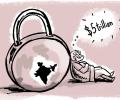
India will need $8 trillion (around Rs 588 lakh crore) of gross capital formation or new greenfield assets to become a $5 trillion (around Rs 368 lakh crore) economy by FY2027, a report said. The report by Deloitte said despite the COVID-19 disruption, FDI inflow into the country provides necessary optimism and display underlying strengths of the Indian economy. In FY2020-21, FDI inflows (including equity, re-invested earnings, and capital) amounted to a record $81.72 billion, 10 per cent higher than the previous financial year, it said.

Of the 1,145 offers made this year, consulting firms made up 34 per cent, followed by banking, financial services and insurance, pharma/healthcare, IT/ITeS and FMCG/retail.

Sections in the draft Personal Data Protection Bill are a blatant violation of the Right to Privacy as guaranteed by the Constitution.

Sanjiv Mehta, chairman of the country's largest consumer goods company, HUL, believes that the second wave of the Covid-19 pandemic between April and June this year has been a mere pause in India's consumption story, and that it will not change the country's overall growth trajectory. India is poised for growth, especially in the fast-moving consumer goods (FMCG) sector, Mehta told shareholders at the company's annual general meeting on Tuesday. The signs of recovery are becoming evident with many states lifting lockdown restrictions in recent weeks.

The new restriction will be challenging for businesses, as they will have to do regular follow-ups with their suppliers.

According to the decision, such entities can now first operate through e-commerce and then open brick-and-mortar stores.
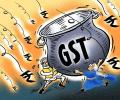
The GST collection in April touched the highest ever level of about Rs 1.68 lakh crore, up 20 per cent from the year-ago period, on improved compliance and recovery in business activity, the Finance Ministry said on Sunday. During the month, 1.06 crore GST returns from GSTR-3B were filed, of which 97 lakh pertained to March 2022. The gross GST revenue collected in April is Rs 1,67,540 crore, of which CGST is Rs 33,159 crore, SGST Rs 41,793 crore, IGST Rs 81,939 crore (including Rs 36,705 crore collected on import of goods) and cess Rs 10,649 crore (including Rs 857 crore collected on import of goods), the ministry said.

Goa, Kerala, Maldives and Dubai are among the popular destinations.

Goods and Services Tax (GST) collections at Rs 95,480 crore in September touched the highest level so far this fiscal, the finance ministry said on Thursday.

'What has happened at Byju's is no surprise to anyone.'

Campa is set to take on its competition, which pushed it out of the aerated drinks business in the late 1990s, but this time with a new owner - Reliance Industries. Campa's entry comes at a time when aerated drinks as a category is already saturated. But experts say this could give rise to competition in the segment, eventually causing the space to grow.

Welcoming the latest round of stimulus announced by Finance Minister Nirmala Sitharaman on Thursday, experts said the measures will support the economic recovery boosting demand, job creation and by providing funds to the MSME and stressed sectors. The fiscal impact of the stimulus is likely to be around 0.25-0.6 per cent of GDP in the current fiscal, they said.

India studied the Malaysian model, which was scrapped on Wednesday, before implementing the GST and borrowed the anti-profiteering clause to ensure GST benefits are passed on to the end-consumer by the industry

The government is looking to plug loopholes in the Indian customs law provision that allows tax exemptions for gifts up to Rs 5,000 and trade samples up to Rs 10,000 sent to India from abroad.

There has been an exponential increase in the use of technology to validate financial numbers, with a greater reliance on electronic evidence, use of live videos where possible, data analytics, and project management software to overcome the physical limitations in verifying transactions and accounts.

Indian rupee, which earlier this week touched an all-time low, is likely to remain under pressure and may test new levels as a fallout of the US Federal Reserve indicating more interest rate hikes, experts said. The aggressive rate hikes will dampen demand and increase the possibility of a recession in the US. This could accelerate the pace of capital outflows, weaken the rupee and raise the threat of imported inflation.

Experts said the risks associated with the Indian Experts say that aviation sector would keep investors away from airline stocks.
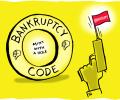
Experts consider Sebi's takeover code in its present form to be on a par with any foreign code governing public mergers and acquisitions.

The regulator last week reached out to custodians for beneficial ownership information of investors coming from China, Hong Kong, and 11 other countries.

Auditors seem to have developed a heightened sense of risk and are not content to tick the boxes and sign the papers.

BlackRock has again reduced the valuation of its share in edtech firm Byju's - this time to about $1 billion, TechCrunch reported on Friday, citing disclosures made by the US-based asset manager. This is 95 per cent less than its peak valuation of $22 billion in 2022. The markdown comes at a time when the company is facing a multitude of challenges, including securing fresh capital, delays in financial reporting and legal disputes with lenders.
 © 2026 Rediff.com - Advertise with us - Disclaimer - Privacy Policy - Sitemap - Feedback - About us - Terms of use - Grievances